
What Triggers a CRA Audit (and How to Avoid One)
CRA doesn't publish its audit-selection algorithm, and most guides fill that gap with invented precision. Here's what CRA actually confirms, the real reassessment periods, and what happens once you're selected.
Most guides to CRA audits describe a precise-sounding risk algorithm, exact ratios that trigger scrutiny, a formula CRA supposedly runs your return through. CRA has never published that algorithm, and no accounting firm has it either, no matter how confidently a blog post presents one. What CRA does confirm is a set of general categories its risk assessment considers, and that's worth knowing precisely, without the invented specificity.
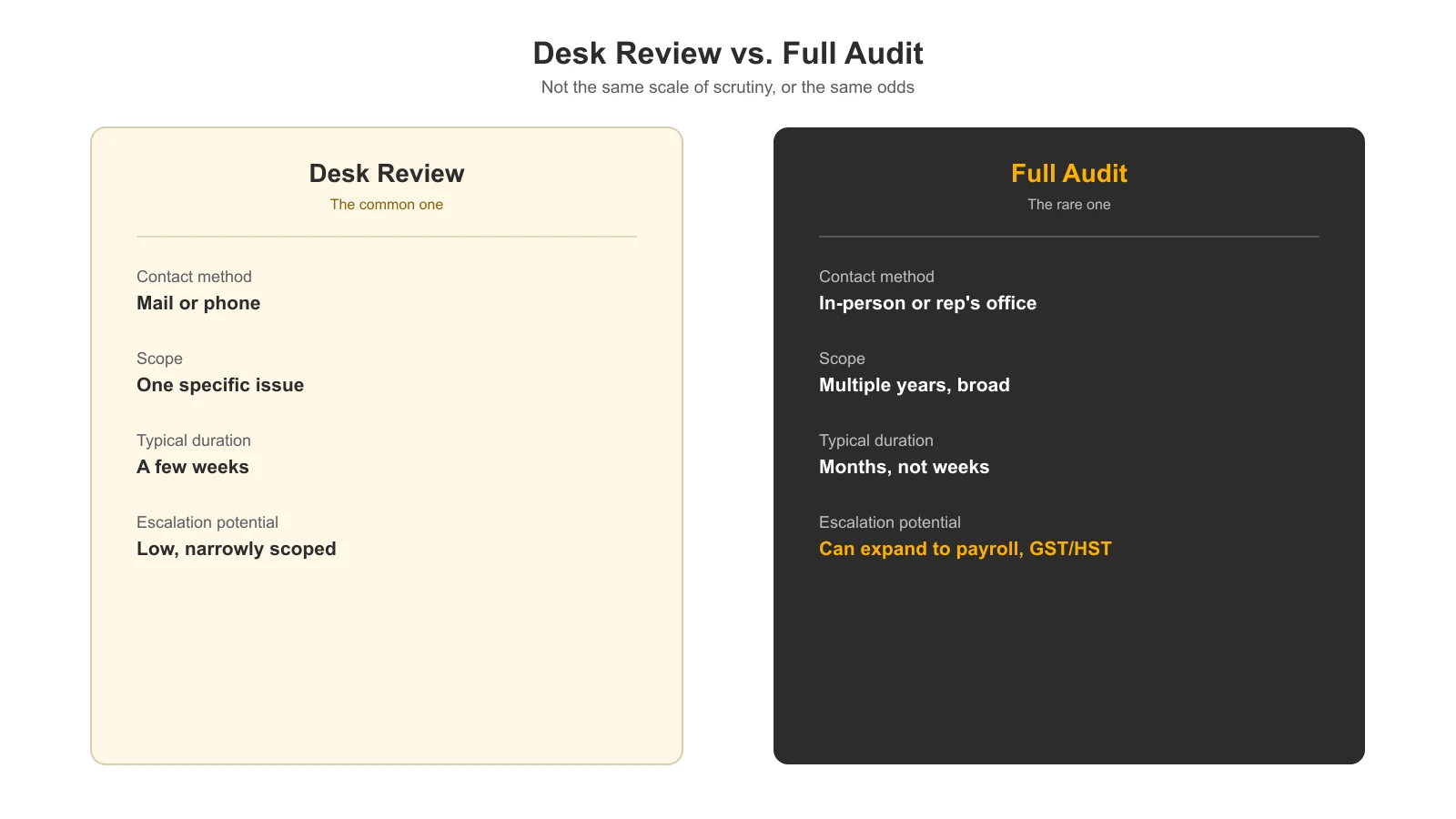
It's also worth knowing that the word "audit" covers two very different things. Most CRA contact is a routine, largely automated desk review, a letter asking for a receipt, resolved in weeks. A full field audit is something else entirely, rarer, broader, and worth understanding on its own terms. This guide covers both honestly: what CRA actually says it looks at, the real reassessment periods, what happens procedurally if you're selected, and what rights you actually have.
The Short Answer: What CRA Confirms, and What It Doesn't
CRA selects files for review using a risk assessment that weighs the likelihood or frequency of errors, indicators of non-compliance, comparisons against similar files and industry data, and leads from other audits or tips. That's the general shape CRA itself confirms. What it doesn't publish is the exact scoring, weighting, or thresholds behind it, so treat any guide claiming a precise formula, including ones with confident-sounding percentages, with real skepticism.
Comparison against industry and similar-file benchmarks
CRA Does Not PublishExact ratios or thresholds that trigger a flagIndicators of non-compliance factor into selection
CRA Does Not PublishHow those indicators are weighted or scoredLeads from other audits and informant tips are used
CRA Does Not PublishHow often tips actually lead to a reviewRandom selection is part of the process
CRA Does Not PublishWhat share of reviews are random versus targeted
| CRA Confirms | CRA Does Not Publish |
|---|---|
| Comparison against industry and similar-file benchmarks | Exact ratios or thresholds that trigger a flag |
| Indicators of non-compliance factor into selection | How those indicators are weighted or scored |
| Leads from other audits and informant tips are used | How often tips actually lead to a review |
| Random selection is part of the process | What share of reviews are random versus targeted |
What Those Categories Actually Mean in Practice
Comparison against industry data generally means CRA has a sense of what a typical business in a given sector reports, revenue, expense ratios, margins, so a return that sits far outside that range for no obvious reason draws more attention than one that tracks close to it. Non-compliance indicators tend to mean things like a history of late filings, prior reassessments, or gaps between what's reported and what third parties, banks, payment processors, other businesses, have already told CRA. None of that translates into a specific number a business can check itself against, since CRA doesn't publish the comparison data itself, only the fact that the comparison happens.
Cash-intensive businesses, restaurants, salons, contractors paid directly, tend to draw more scrutiny for a structural reason rather than any specific wrongdoing: cash transactions are harder to verify against a paper trail than card or e-transfer payments, so an auditor has less to independently confirm income against. That's a pattern CRA has spoken about publicly in general terms, not a confirmed algorithm weight, but it's consistent enough across real files to be worth knowing.
Desk Review vs. Full Audit: Not the Same Thing
A desk review, sometimes called a correspondence or matching review, is the far more common form of CRA contact. It's handled by mail or phone, targets one specific issue or slip, a T4 that doesn't match, a receipt for a claimed deduction, and is typically resolved in a few weeks once the requested documents are sent in. A full field audit is a different scale of scrutiny: an in-person or representative-office review covering multiple years and potentially expanding into payroll or GST/HST if something concerning turns up, generally taking months rather than weeks. CRA doesn't publish exact timelines for either, so those durations reflect common professional experience, not an official CRA figure.
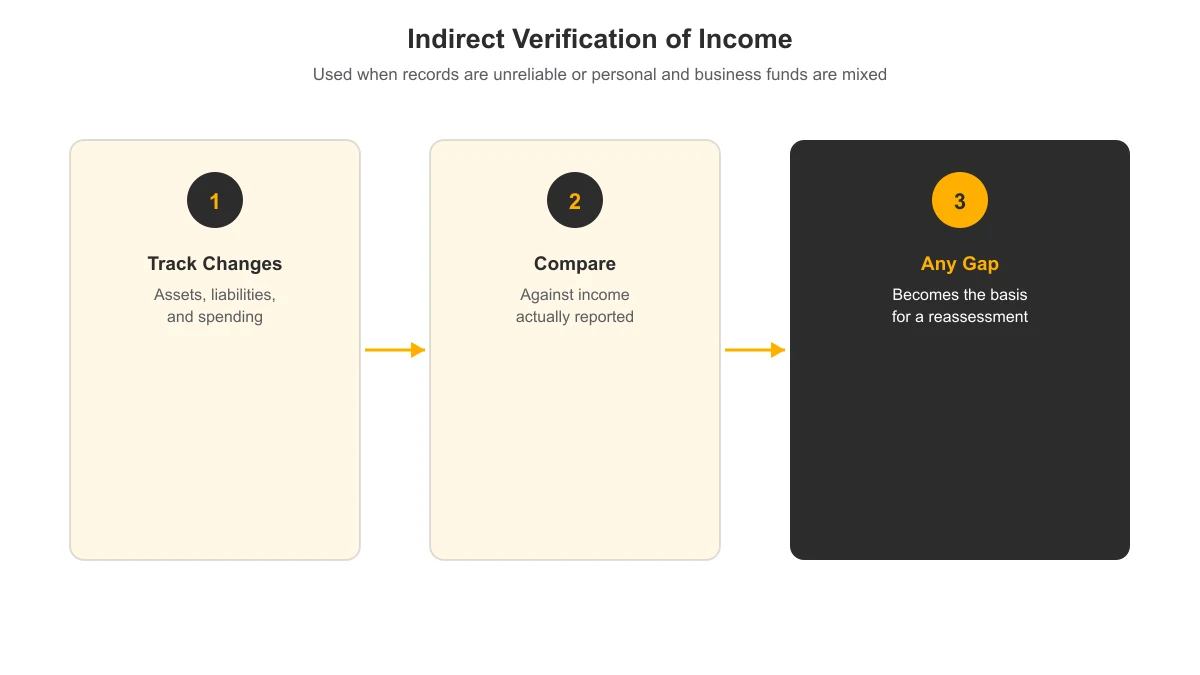
Field audits sometimes use what's called the indirect verification of income method, essentially reconstructing income by tracking changes in assets, liabilities, and spending, used specifically when records are unreliable or missing, or when personal and business funds have been mixed together. It's the exact scenario clean, separated bookkeeping is designed to prevent, since a business with clear records rarely gives an auditor a reason to reach for it.
How Far Back CRA Can Actually Go
This is the number most guides get vague about, and it varies by return type. Individual T1 returns generally have a three-year reassessment window from the date of the original Notice of Assessment. Corporate T2 returns run three years for a Canadian-controlled private corporation and four years for a non-CCPC, both counted from the original Notice of Assessment date.
Individual (T1)
Reassessment Window3 years from the original Notice of AssessmentCorporate, CCPC (T2)
Reassessment Window3 years from the original Notice of AssessmentCorporate, non-CCPC (T2)
Reassessment Window4 years from the original Notice of AssessmentAny return, if misrepresentation is found
Reassessment WindowNo time limit
| Return Type | Reassessment Window |
|---|---|
| Individual (T1) | 3 years from the original Notice of Assessment |
| Corporate, CCPC (T2) | 3 years from the original Notice of Assessment |
| Corporate, non-CCPC (T2) | 4 years from the original Notice of Assessment |
| Any return, if misrepresentation is found | No time limit |
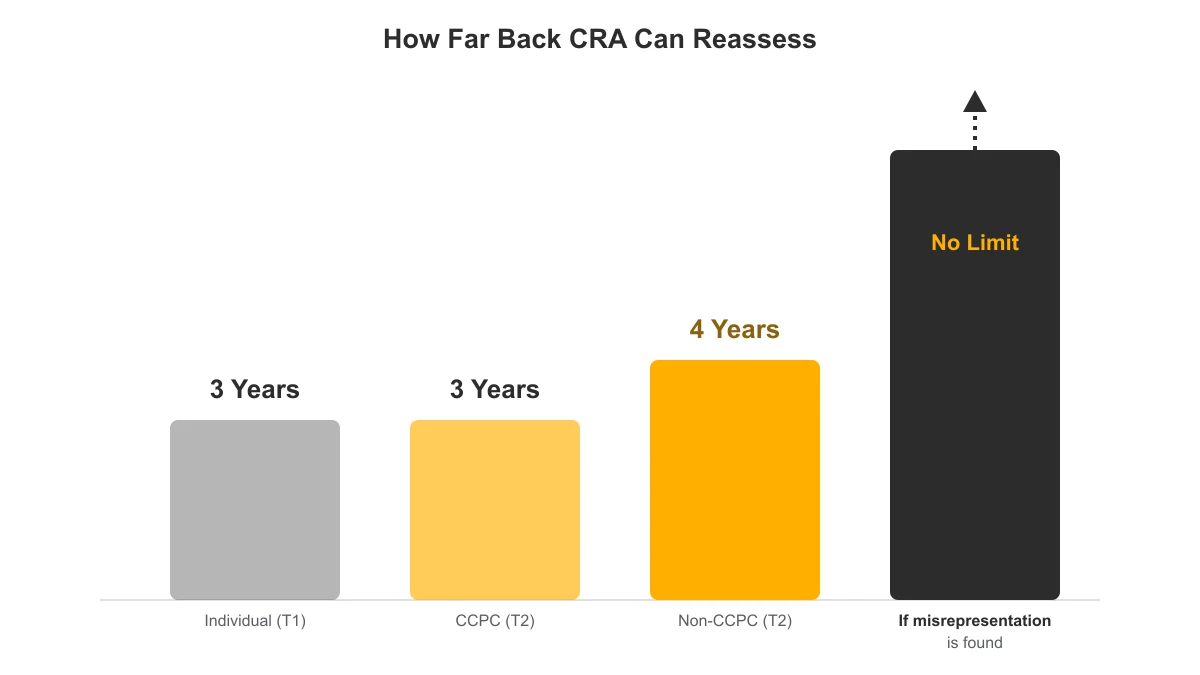
Those windows extend further in specific situations, certain non-arm's-length loss carrybacks can add several additional years, and some provincial reallocation cases add one. None of that matters if CRA determines a return involved misrepresentation attributable to neglect, carelessness, wilful default, or fraud, or if unreported real estate dispositions turn up: in those cases, there's no time limit at all. The same is true if a taxpayer has signed a waiver on a specific matter, form T2029, which keeps that issue open indefinitely by choice.
Why Six Years, Not Three or Four
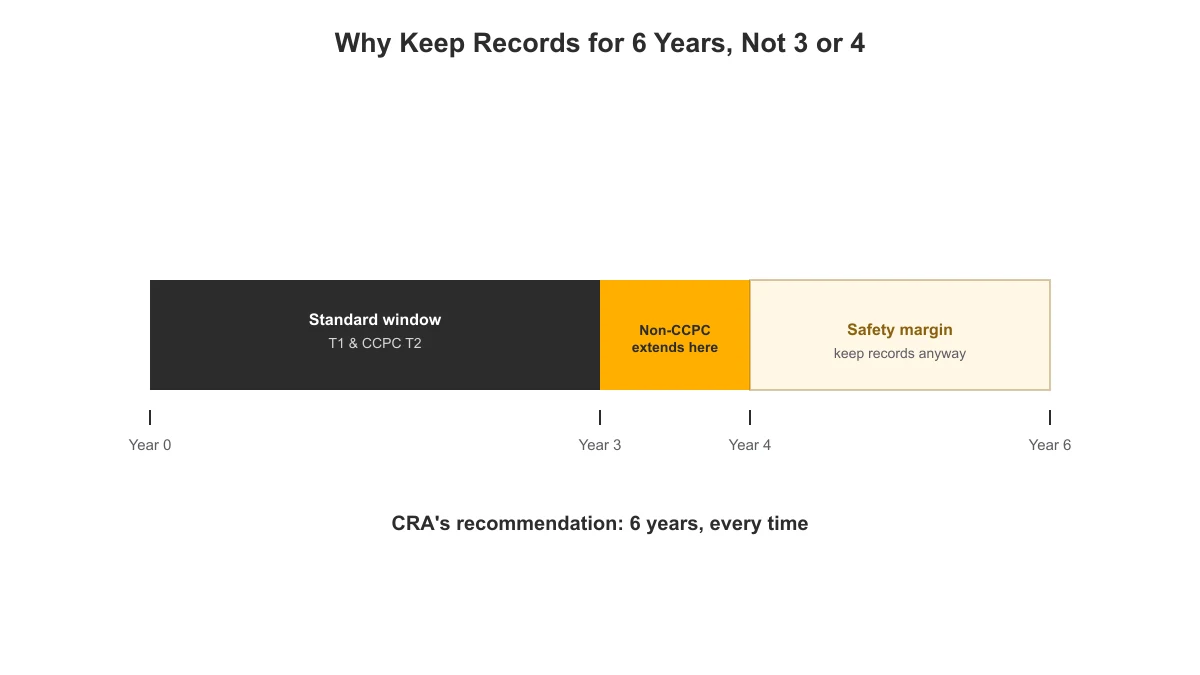
CRA's general recommendation is to keep supporting records for a minimum of six years, longer than the standard three or four-year reassessment window for a reason: it covers the normal window with margin, plus enough runway to handle a return that gets reassessed close to the deadline, or where an extended-period situation applies. Six years, not the three or four most people assume matches their actual risk, is the number worth building retention habits around.
What Actually Happens Once You're Selected
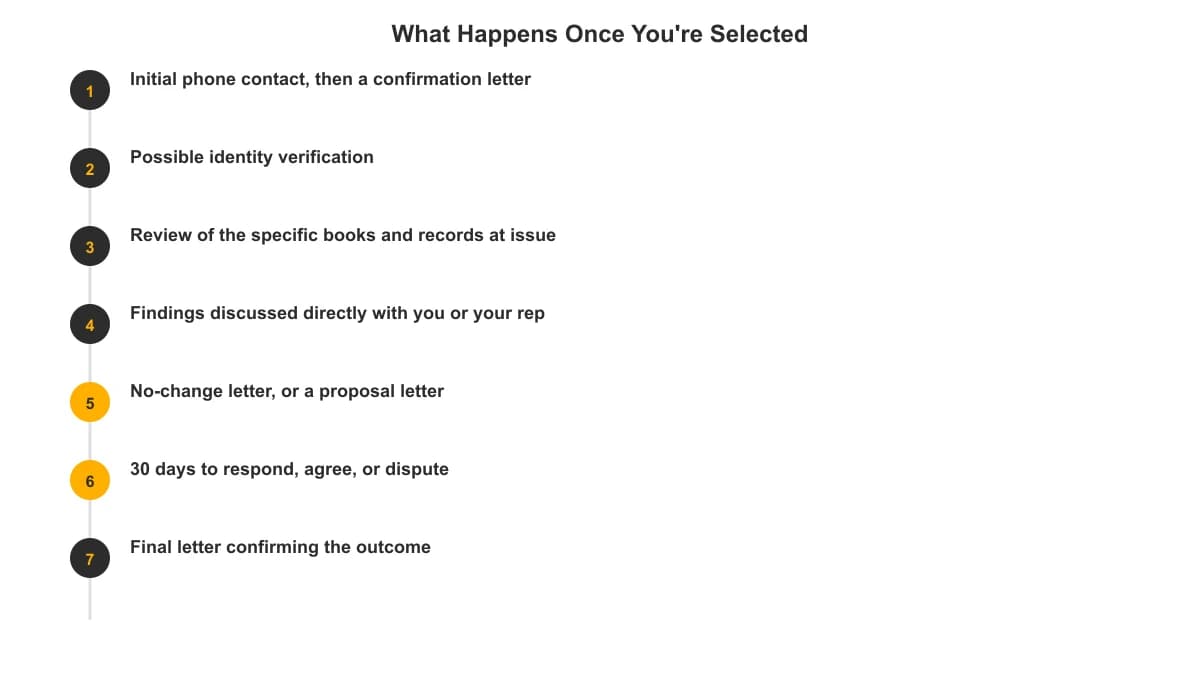
The process follows a fairly consistent shape regardless of whether it's a desk review or a full audit, just at different scales. An auditor makes initial contact by phone, usually followed by a confirmation letter, and may ask for identity verification before anything else proceeds. From there, they review the books, records, and supporting documents relevant to the issue, and discuss any findings directly before anything is finalized.
- Initial contact by phone, followed by a confirmation letter
- Possible identity verification before the review proceeds
- Review of the specific books, records, and documents at issue
- A discussion of findings directly with the taxpayer or their representative
- Either a no-change letter, or a proposal letter outlining adjustments
- 30 days to respond, agree, or dispute the proposal before it's finalized
- A final letter confirming the outcome and any reassessment
What Rights You Actually Have
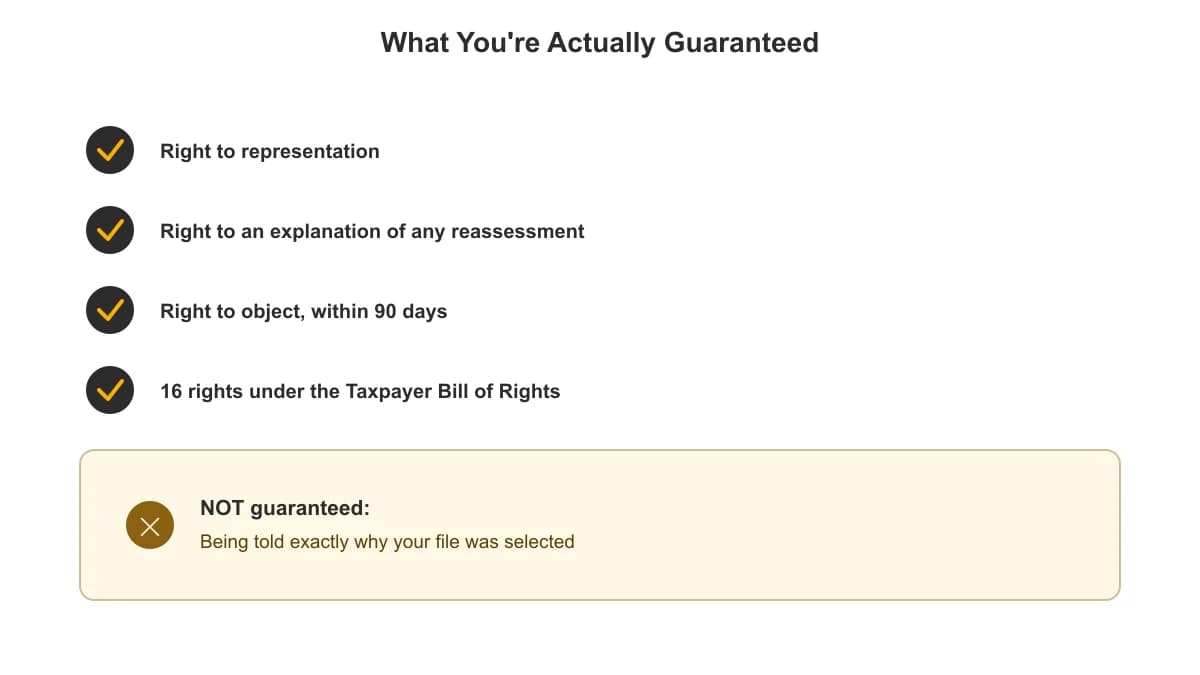
The Taxpayer Bill of Rights sets out sixteen specific rights, including the right to retain a representative and have CRA deal with them directly, the right to receive an explanation for a reassessment, and the right to file a formal objection, generally within 90 days of the date on the Notice of (Re)assessment. One right people often assume exists but isn't guaranteed: being told exactly why a specific file was selected for review. CRA isn't obligated to disclose that, which is part of why guides promising to reveal "the real reason" a file gets flagged are overstating what's actually knowable.
The businesses that handle a CRA letter calmly aren't the ones who never get selected. They're the ones whose books already answer the question before the auditor finishes asking it.
What Actually Reduces Risk
Since CRA's exact criteria aren't public, the honest version of "reducing risk" is really about not giving a reviewer an easy reason to dig further. Keeping personal and business spending in separate accounts, maintaining bookkeeping that's current rather than reconstructed after the fact, keeping receipts for anything claimed as a deduction, and responding to any CRA correspondence promptly rather than letting a desk-review letter sit unanswered are the practical habits that come up repeatedly across real files, not because they guarantee anything, but because a business that already has clean answers rarely turns a routine question into something bigger.
Self-employed filers and incorporated owner-managers, covered in our self-employed tax filing guide, generally see more of this scrutiny than someone with a single T4 slip, simply because there's more room for a mismatch between reported income and actual activity. That's not a reason to worry, just a reason those filers specifically benefit from tighter records.
Already Got a Letter?
If CRA has already been in touch, or you're aware of a past error you haven't corrected, the Voluntary Disclosures Program exists specifically for coming forward before CRA finds it independently, and can reduce penalties that would otherwise apply. Our tax services team handles both sides of this: getting ahead of a filing before it becomes a problem, and representing a business once a review or audit letter has already landed.
Book a free call and we'll help you figure out exactly where you stand.
On this page
Never miss a deadline again
We track every filing date for our clients. Let us watch yours.
Book a free callAccounting Firm Mississauga Team
A practice of expert accountants filing returns for Mississauga businesses and individuals for close to a decade. We write these to answer the questions clients actually ask.
Frequently Asked Questions
What actually triggers a CRA audit?
CRA doesn't publish its exact selection criteria. It confirms a risk assessment that considers the likelihood of errors, non-compliance indicators, comparisons against industry and similar-file benchmarks, and leads from other audits or tips, plus a random-selection component. Any guide claiming to know the precise formula is overstating what's actually public.
What's the difference between a CRA desk review and a full audit?
A desk (correspondence) review is handled by mail or phone, targets one specific issue, and is usually resolved within weeks. A full field audit is broader, often in-person, can cover multiple years, and may expand into payroll or GST/HST, generally taking months rather than weeks.
How far back can CRA audit or reassess a return?
Generally 3 years from the original Notice of Assessment for individuals and CCPCs, and 4 years for non-CCPC corporations. If CRA finds misrepresentation attributable to neglect, carelessness, wilful default, or fraud, there's no time limit at all.
How long should I keep my tax records?
CRA recommends a minimum of six years, longer than the standard 3 or 4-year reassessment window, to cover it with margin plus room for a return reassessed close to the deadline or under an extended-period situation.
Do I have the right to know why I was selected for a CRA audit?
Not guaranteed. The Taxpayer Bill of Rights covers things like the right to representation, an explanation of a reassessment, and the right to object, but CRA isn't obligated to disclose the specific reason a file was selected for review.
What happens if I disagree with a CRA audit's findings?
You generally have 30 days to respond to a proposal letter before it's finalized, and can file a formal objection within 90 days of the date on the resulting Notice of (Re)assessment if you still disagree once it's issued.
Recent posts
View all → Tax Deadlines
The Complete 2026 Canada Tax Deadline Calendar
Every CRA deadline that matters in 2026, personal, self-employed, corporate, GST/HST, payroll, and RRSP, in one place, plus the small-CCPC test two of them secretly share.
 Payroll
Payroll Remittance Deadlines: What New Employers Actually Need to Know
Priya's corporation just became a remitter for the first time. Real 2026 numbers on remitter types, due dates, and the penalty rule most guides get wrong.
 Audit & Assurance
Audit vs. Review vs. Compilation: What Your Business Actually Needs
A bank, franchisor, or investor just asked for "reviewed" or "audited" statements. Here's what each assurance level actually means, what it costs in the GTA, and how to know which one applies to you.
Free Consultation
Tell Us What You Need. Get a Real Answer Back.
No sales script, no obligation. Describe your situation once and an accounting specialist will follow up with a straight answer and a flat quote.
- Flat-fee quote before any work starts
- Response within one business day
- Reviewed by an expert accountant, not just a bookkeeper