
The Complete 2026 Canada Tax Deadline Calendar
Every CRA deadline that matters in 2026, personal, self-employed, corporate, GST/HST, payroll, and RRSP, in one place, plus the small-CCPC test two of them secretly share.
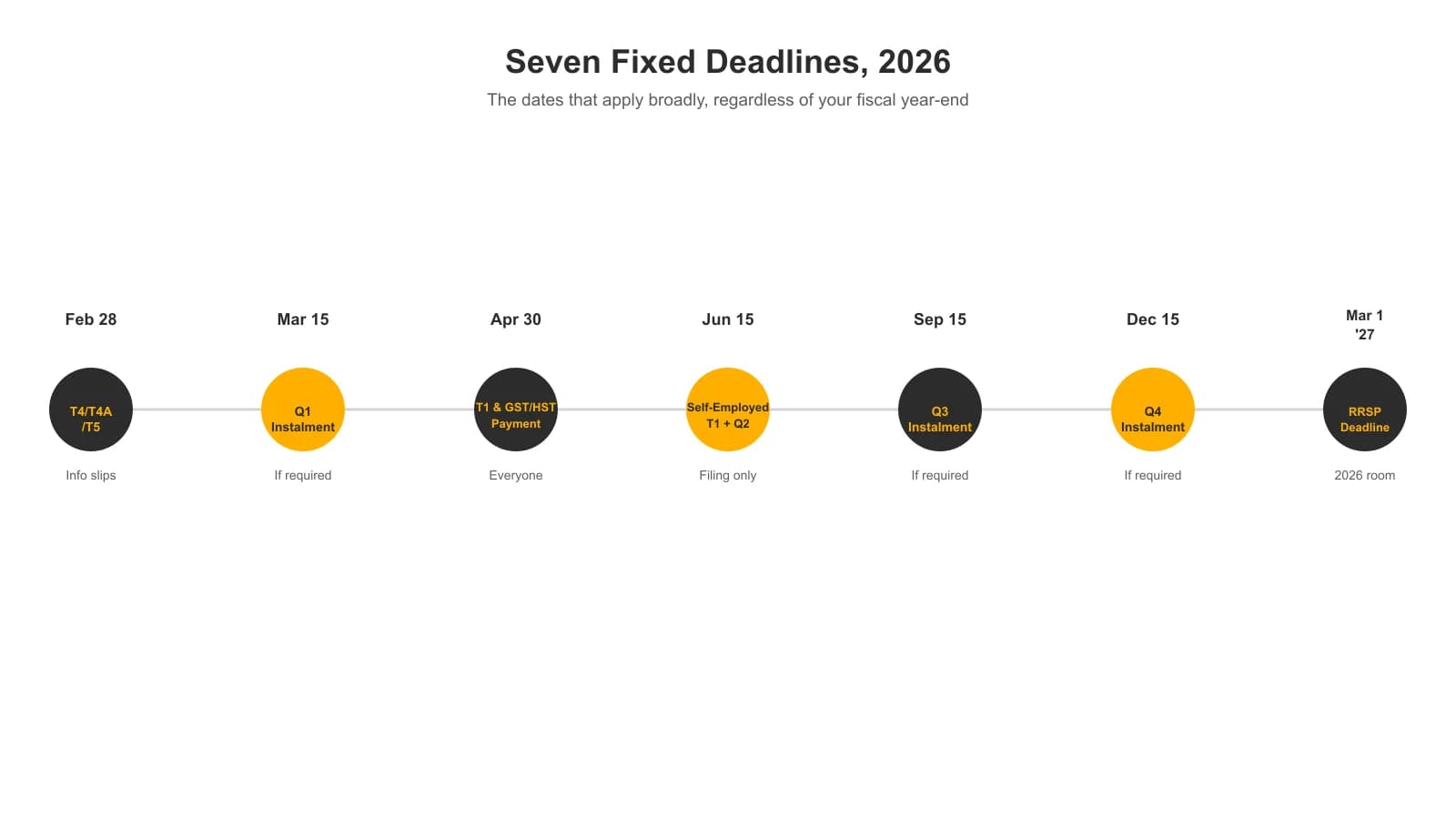
Every deadline in this guide exists somewhere on canada.ca, spread across a dozen different pages written for a dozen different situations. Nowhere does CRA put the personal deadline next to the corporate one next to the GST/HST one, even though most business owners are juggling three or four of these at once. This page is that missing view: every fixed 2026 deadline in one place, plus the formulas behind the ones that depend on your own fiscal year.
Use it two ways. Scan the quick calendar below for what's coming up next, or jump to the section for your specific situation for the full mechanics. Where this site already has a deeper guide on a topic, self-employed T1 filing, incorporating, or payroll remittances, this page links out rather than repeating it, so the detail lives in one place and stays consistent.
The Quick Calendar: Fixed 2026 Dates
These dates apply broadly, regardless of your business's own fiscal year-end. Recurring monthly and quarterly obligations, GST/HST filings and payroll remittances, aren't fixed calendar dates the same way, so they're covered in their own sections below instead of repeated twelve times here.
February 28, 2026
DeadlineT4, T4A, and T5 slips due, for the 2025 tax yearMarch 15, 2026
DeadlineQ1 personal tax instalment, if requiredApril 30, 2026
DeadlineT1 filing and payment for individuals; GST/HST payment for individual annual filersJune 15, 2026
DeadlineT1 filing for self-employed individuals and spouses; GST/HST filing for individual annual filers; Q2 personal tax instalment, if requiredSeptember 15, 2026
DeadlineQ3 personal tax instalment, if requiredDecember 15, 2026
DeadlineQ4 personal tax instalment, if requiredMarch 1, 2027
DeadlineRRSP contribution deadline for the 2026 tax year
| Date | Deadline |
|---|---|
| February 28, 2026 | T4, T4A, and T5 slips due, for the 2025 tax year |
| March 15, 2026 | Q1 personal tax instalment, if required |
| April 30, 2026 | T1 filing and payment for individuals; GST/HST payment for individual annual filers |
| June 15, 2026 | T1 filing for self-employed individuals and spouses; GST/HST filing for individual annual filers; Q2 personal tax instalment, if required |
| September 15, 2026 | Q3 personal tax instalment, if required |
| December 15, 2026 | Q4 personal tax instalment, if required |
| March 1, 2027 | RRSP contribution deadline for the 2026 tax year |
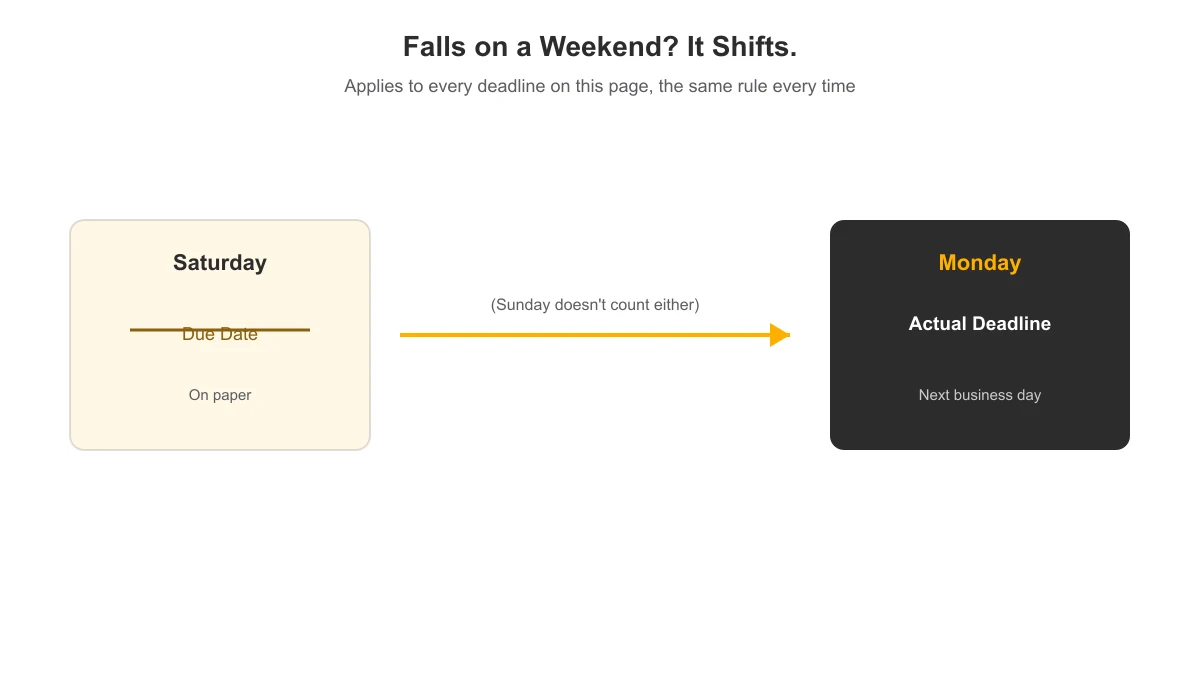
If any date above falls on a Saturday, Sunday, or a public holiday CRA recognizes, it's considered on time if received the next business day, a rule that applies consistently across every deadline category on this page, personal, corporate, GST/HST, and information slips alike.
Individuals
For anyone without self-employment income, the deadline is simple: file and pay by April 30, 2026. There's no separate filing extension the way self-employed filers get, and interest on any balance owing starts accruing May 1 regardless of when the return actually gets filed.
Self-Employed Individuals
Self-employed individuals, and their spouse or common-law partner even if that spouse isn't self-employed, get until June 15, 2026 to file. Any balance owing is still due April 30, 2026, the same as everyone else, so the extra six weeks is a paperwork extension only. Quarterly instalments, when required, follow the March 15, June 15, September 15, and December 15 dates in the table above. The full mechanics, including CPP, T2125 deductions, and a real worked example, are covered in our self-employed tax filing guide.
One narrow exception: if a business's expenditures were primarily tax-shelter investments, the June 15 extension doesn't apply and the deadline reverts to April 30. It's a rare situation for most small businesses, but it's the one stated exception CRA carves out of the self-employed extension.
Corporations
A T2 corporate return is due six months after the end of the corporation's tax year, for every corporation, regardless of size or structure. A corporation with a December 31 year-end, the most common setup, must file by June 30, 2026, for its 2025 tax year.
Balance owing is a separate, earlier deadline. The default is two months after year-end. A Canadian-controlled private corporation gets three months instead, but only if it passes what amounts to a small-business test.
The Small-CCPC Test
This test shows up twice in the corporate deadlines below, so it's worth stating once clearly. A corporation qualifies as a small CCPC if it was a CCPC throughout the tax year, claimed the small business deduction in the current or previous tax year, and its taxable income, combined with any associated corporations, didn't exceed the $500,000 business limit in the prior year. Meeting this test is what unlocks the three-month balance-due window instead of two.
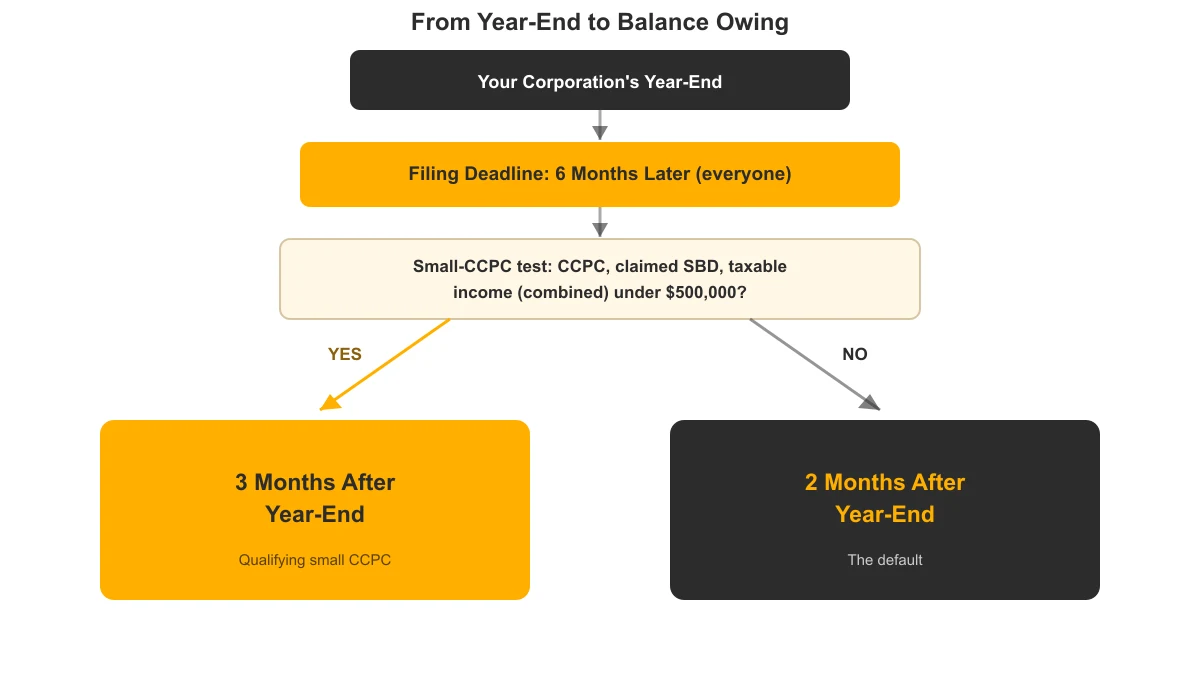
The same test, with a wider financial condition added, also determines whether a corporation can pay quarterly instalments instead of monthly. Quarterly eligibility requires CCPC status, a perfect compliance history over the prior 12 months, combined taxable income under $500,000, and combined taxable capital employed in Canada under $10 million. Everyone else pays monthly, due the last day of each month for a calendar-year corporation. Our sole proprietorship vs. corporation guide covers what incorporating actually changes about a tax bill in the first place.
GST/HST Filing
Once registered, whether that's because you crossed the $30,000 threshold or registered voluntarily, CRA assigns a filing frequency based on annual taxable supplies: annually under $1.5 million, quarterly between $1.5 million and $6 million, and monthly above $6 million. Our HST/GST registration guide covers how that $30,000 threshold itself works.
Monthly
Annual Taxable SuppliesOver $6 millionDeadline1 month after the reporting period endsQuarterly
Annual Taxable Supplies$1.5 million to $6 millionDeadline1 month after the reporting period endsAnnual (corporation or general)
Annual Taxable SuppliesUnder $1.5 millionDeadline3 months after fiscal year-endAnnual (individual, Dec 31 year-end)
Annual Taxable SuppliesUnder $1.5 millionDeadlineFiling June 15, 2026; payment April 30, 2026
| Filing Frequency | Annual Taxable Supplies | Deadline |
|---|---|---|
| Monthly | Over $6 million | 1 month after the reporting period ends |
| Quarterly | $1.5 million to $6 million | 1 month after the reporting period ends |
| Annual (corporation or general) | Under $1.5 million | 3 months after fiscal year-end |
| Annual (individual, Dec 31 year-end) | Under $1.5 million | Filing June 15, 2026; payment April 30, 2026 |
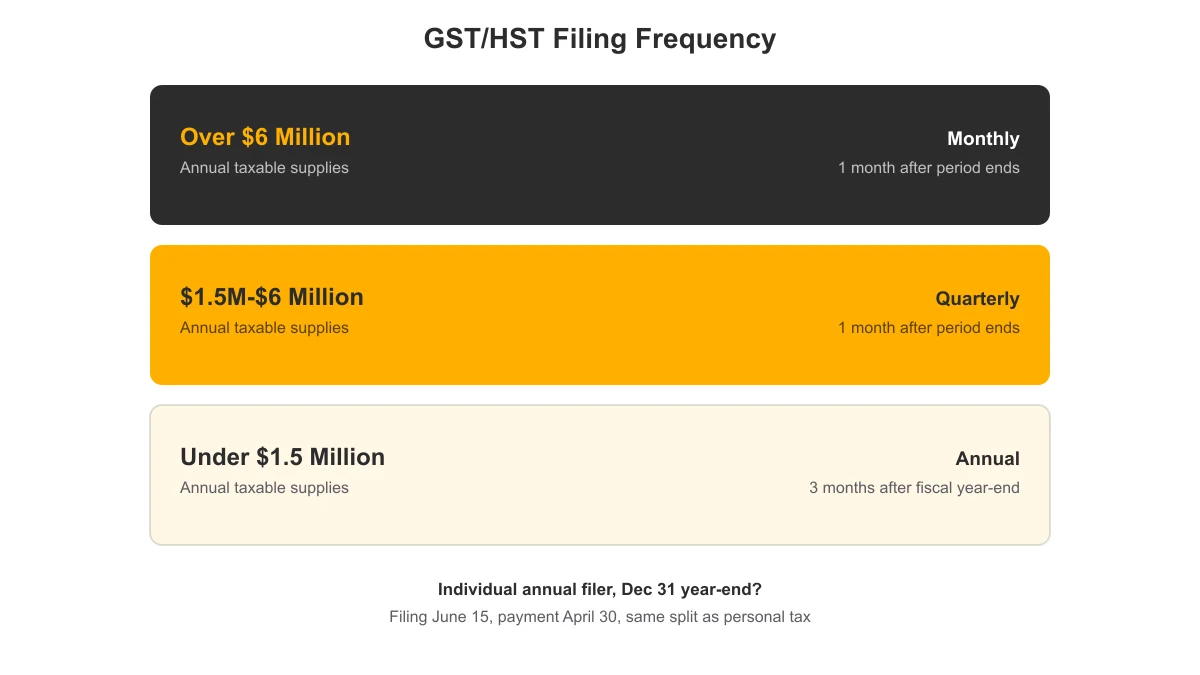
That last row is the one people miss: an individual annual filer with a December 31 year-end gets the exact same split as personal income tax, filing due June 15 but payment still due April 30, not one combined date.
Employers: Slips and Payroll Remittances
T4, T4A, and T5 information slips and summaries are all due the same day: the last day of February following the calendar year they cover. For 2025 wages and investment income, that's February 28, 2026.
1 to 50
Penalty per Day Late$10Maximum$1,00051 to 500
Penalty per Day Late$15Maximum$1,500501 to 2,500
Penalty per Day Late$25Maximum$2,5002,501 to 10,000
Penalty per Day Late$50Maximum$5,00010,001+
Penalty per Day Late$75Maximum$7,500
| Number of Slips | Penalty per Day Late | Maximum |
|---|---|---|
| 1 to 50 | $10 | $1,000 |
| 51 to 500 | $15 | $1,500 |
| 501 to 2,500 | $25 | $2,500 |
| 2,501 to 10,000 | $50 | $5,000 |
| 10,001+ | $75 | $7,500 |
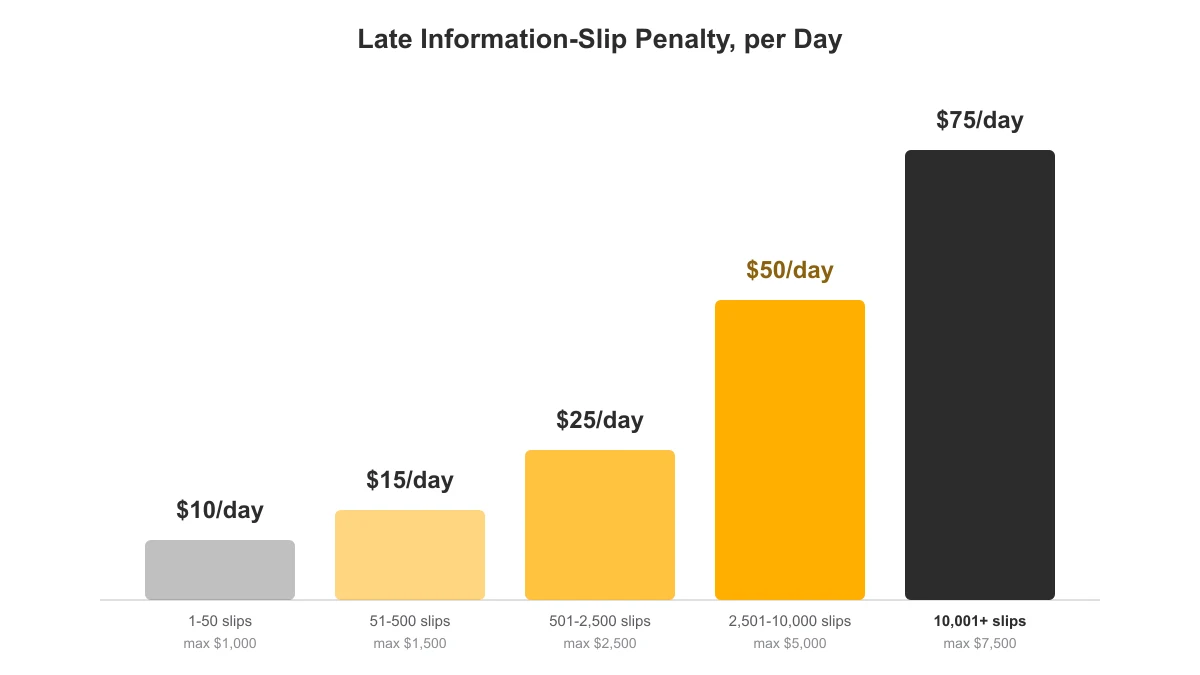
That's a separate penalty from the one owed for not giving an employee their own copy of a T4, a distinct $25-a-day charge, minimum $100, that gets conflated with the slip-filing penalty more often than it should. Payroll remittances, the actual CPP, EI, and income tax withheld from paycheques, run on their own schedule entirely, tied to remitter type rather than a single annual date. Our payroll remittance guide covers all four remitter types and their due dates in full.
RRSP Contributions
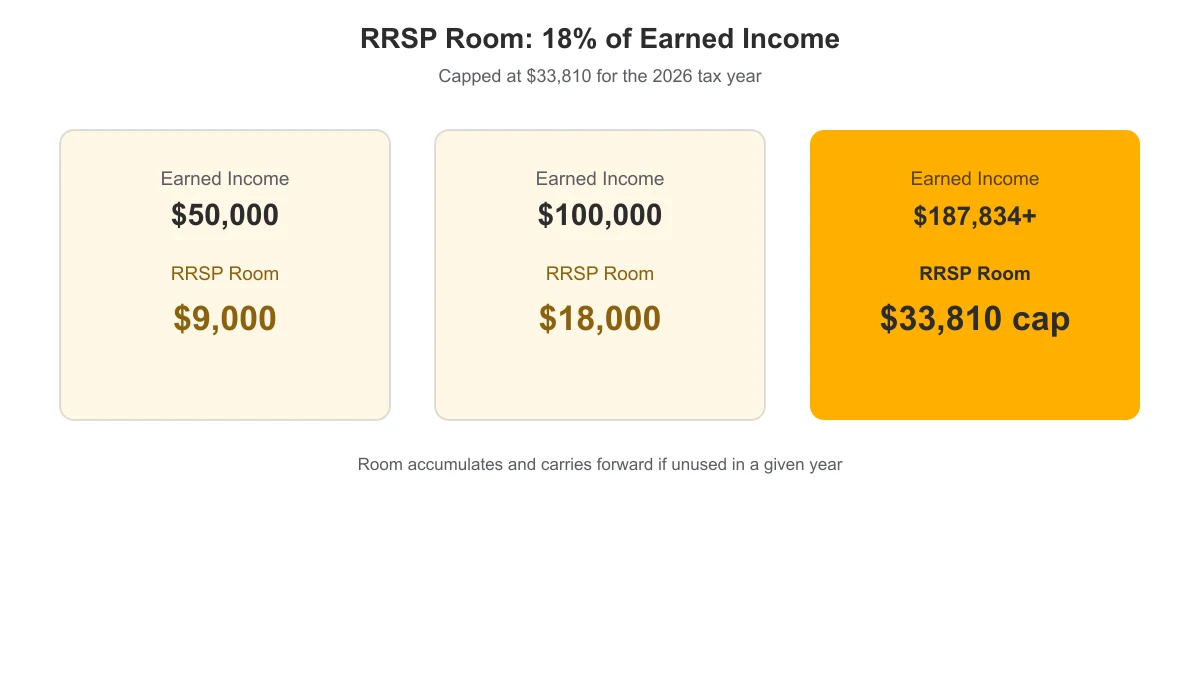
The RRSP contribution deadline for a given tax year falls 60 days after December 31. For the 2026 tax year, that's March 1, 2027, contributions made any time during 2026 or in that first 60-day window of 2027 both count toward the 2026 return. Contribution room is 18 percent of the prior year's earned income, up to an annual maximum; for 2026, that maximum is $33,810.
Nobody misses a deadline because the date was hard to find. They miss it because it was on a different page than the four other deadlines due the same month.
Never Track These Manually Again
Every business here is juggling a different combination of these dates, personal, corporate, GST/HST, payroll, sometimes all four on different schedules. Our accounting and tax services track the specific deadlines that apply to your business and file ahead of them, so this page is a reference for you, not something we're relying on ourselves.
Book a free call and we'll map out exactly which of these deadlines apply to you.
On this page
Never miss a deadline again
We track every filing date for our clients. Let us watch yours.
Book a free callAccounting Firm Mississauga Team
A practice of expert accountants filing returns for Mississauga businesses and individuals for close to a decade. We write these to answer the questions clients actually ask.
Frequently Asked Questions
When is the T2 corporate tax return due in 2026?
Six months after the end of the corporation's tax year, for every corporation. A corporation with a December 31, 2025 year-end must file by June 30, 2026. Balance owing is a separate, earlier deadline: two months after year-end by default, or three months for a qualifying small CCPC.
What is the small-CCPC test for the three-month balance-due extension?
A corporation qualifies if it was a CCPC throughout the tax year, claimed the small business deduction in the current or previous year, and its taxable income, combined with any associated corporations, stayed under the $500,000 business limit in the prior year. The same test, with an added $10 million taxable capital condition, also determines eligibility for quarterly instalments.
When do GST/HST returns have to be filed in 2026?
It depends on filing frequency, assigned based on annual taxable supplies: monthly and quarterly filers have 1 month after the reporting period ends, and annual filers have 3 months after fiscal year-end, except individual annual filers with a December 31 year-end, who follow the same split as personal tax: filing due June 15, 2026, payment due April 30, 2026.
When are T4 slips due for 2025?
February 28, 2026, the last day of February following the calendar year the slips cover. The same deadline applies to T4A and T5 slips. Late filing triggers a per-day penalty based on how many slips are involved, separate from the penalty for not giving an employee their own T4 copy.
What is the RRSP contribution deadline for 2026?
March 1, 2027, which is 60 days after December 31, 2026. Contributions made anytime during 2026, or in that first 60 days of 2027, both count toward the 2026 tax year. The 2026 contribution maximum is $33,810, or 18 percent of prior-year earned income, whichever is lower.
Does the weekend rule apply to every CRA deadline?
Yes. When a due date falls on a Saturday, Sunday, or a public holiday CRA recognizes, the deadline is considered met if it's received the next business day. This applies consistently across personal, corporate, GST/HST, and information slip deadlines.
Recent posts
View all → Payroll
Payroll Remittance Deadlines: What New Employers Actually Need to Know
Priya's corporation just became a remitter for the first time. Real 2026 numbers on remitter types, due dates, and the penalty rule most guides get wrong.
 Audit & Assurance
Audit vs. Review vs. Compilation: What Your Business Actually Needs
A bank, franchisor, or investor just asked for "reviewed" or "audited" statements. Here's what each assurance level actually means, what it costs in the GTA, and how to know which one applies to you.
 Corporate Tax
Should You Incorporate? What It Actually Changes About Your Taxes
Incorporating doesn't erase your tax bill, it defers it. A real worked example, using 2026's new small business rate, of what actually changes when you stop being a sole proprietor.
Free Consultation
Tell Us What You Need. Get a Real Answer Back.
No sales script, no obligation. Describe your situation once and an accounting specialist will follow up with a straight answer and a flat quote.
- Flat-fee quote before any work starts
- Response within one business day
- Reviewed by an expert accountant, not just a bookkeeper